Freezer Repair
Frost Comes Back a Week After You Clear It
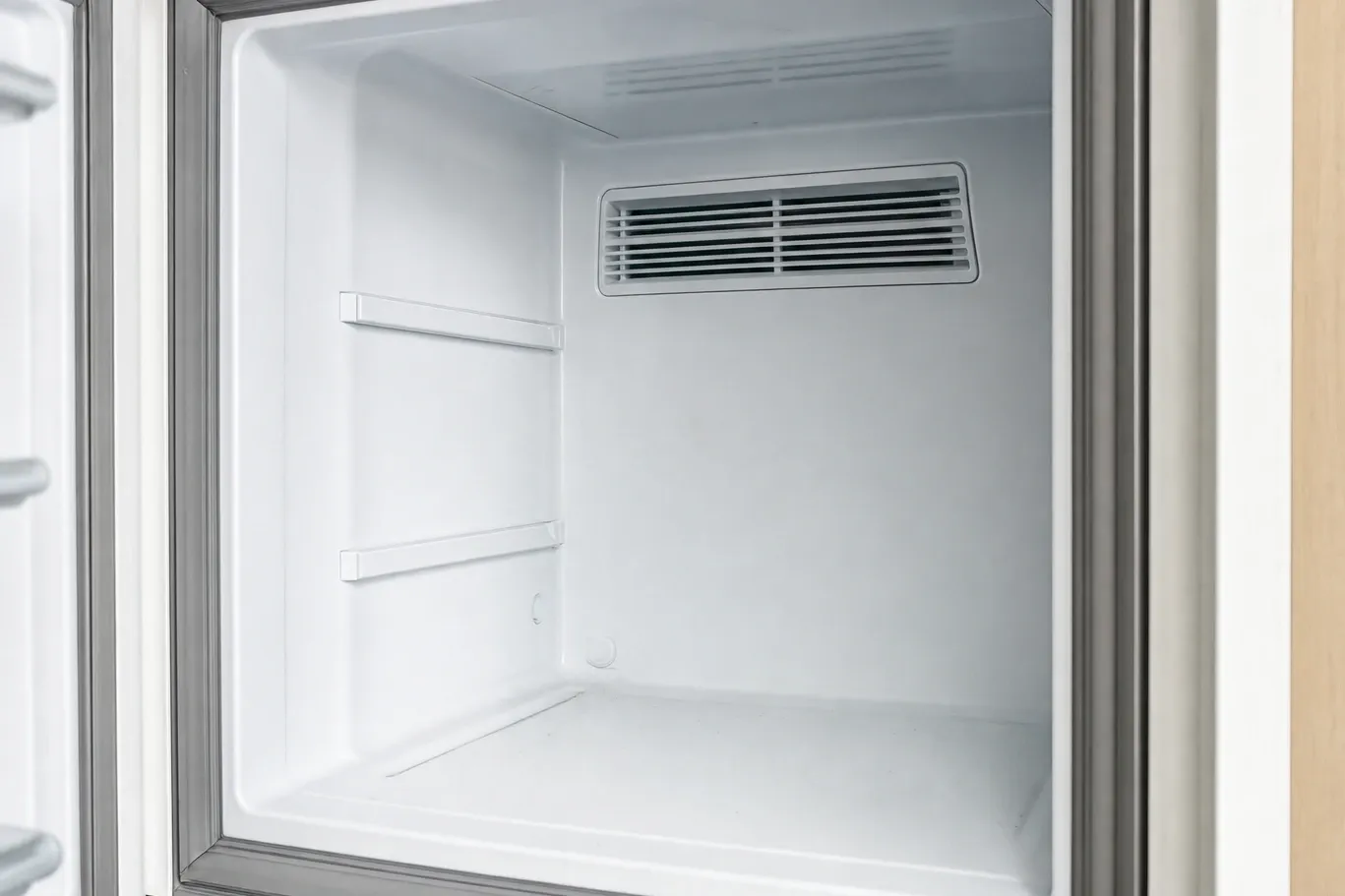
You clear the ice out on a Sunday morning — chipping carefully, a bowl of warm water, towels down — and the compartment looks factory-new by lunchtime. Six days later there is a rind of frost on the rear panel again, the drawer is stiff, and you are back where you started with less enthusiasm.
That week is the diagnosis. Frost that takes months to build is a door being opened in a humid kitchen. Frost that rebuilds inside a week is a cabinet that has stopped getting rid of its own meltwater, and no amount of clearing it out changes that. The two faults behind it are ordinary, cheap to test and cheap to put right — but only if somebody tests them instead of clearing the ice again.
What the ice is actually telling you
Every cold surface in a freezer collects moisture, and the design assumes it. The evaporator behind the rear panel frosts over as it works, and at intervals through the day a heating element comes on to take that frost straight back off it. The water runs down into a trough, out through a drain tube, and into a pan near the compressor, where waste heat from the machinery evaporates it away. That loop repeats for years and you never see any part of it happen.
Break the loop anywhere and the water has to go somewhere else. It refreezes on the coil, on the panel, in the trough, or under the bottom drawer — and each cycle adds to what is already there rather than removing it. That is why the build is exponential rather than steady: the more ice there is, the less air moves, the colder the surfaces run, and the faster the next layer forms.
So the useful question is never “how do I get this ice out”. It is “which part of that loop stopped”.
Two faults, and how to tell them apart
The defrost circuit is not running. A heater that has gone open circuit, a terminator that no longer closes, or a control that is not calling for the cycle at all. The signature is frost distributed evenly across the whole evaporator, often with the fan blades iced in, and a compartment that is slowly losing temperature even though the compressor sounds like it is running constantly. Ice cream goes soft first; the display goes on insisting everything is fine, because the sensor it is reading sits in moving air that has not arrived.
The drain is blocked. Here the defrost cycle runs perfectly — and the water it produces cannot leave. It backs up in the trough, freezes into a solid bar, and the next cycle’s meltwater sits on top of that. The signature is different and much more specific: ice concentrated low in the compartment, a sheet under the bottom drawer, sometimes water finding its way out of the door seal and onto the floor. The compartment temperature is often still fine, which is exactly why this one gets ignored until the drawer will not close.
You can usually separate them yourself before anyone is called. Take everything out, and look at where the ice is heaviest. High and even across the rear panel points at the defrost circuit. Low, in a slab, with the upper coil area comparatively clean, points at the drain. If there is water on the kitchen floor, it is the drain and it has been for a while.
What actually gets tested on the visit
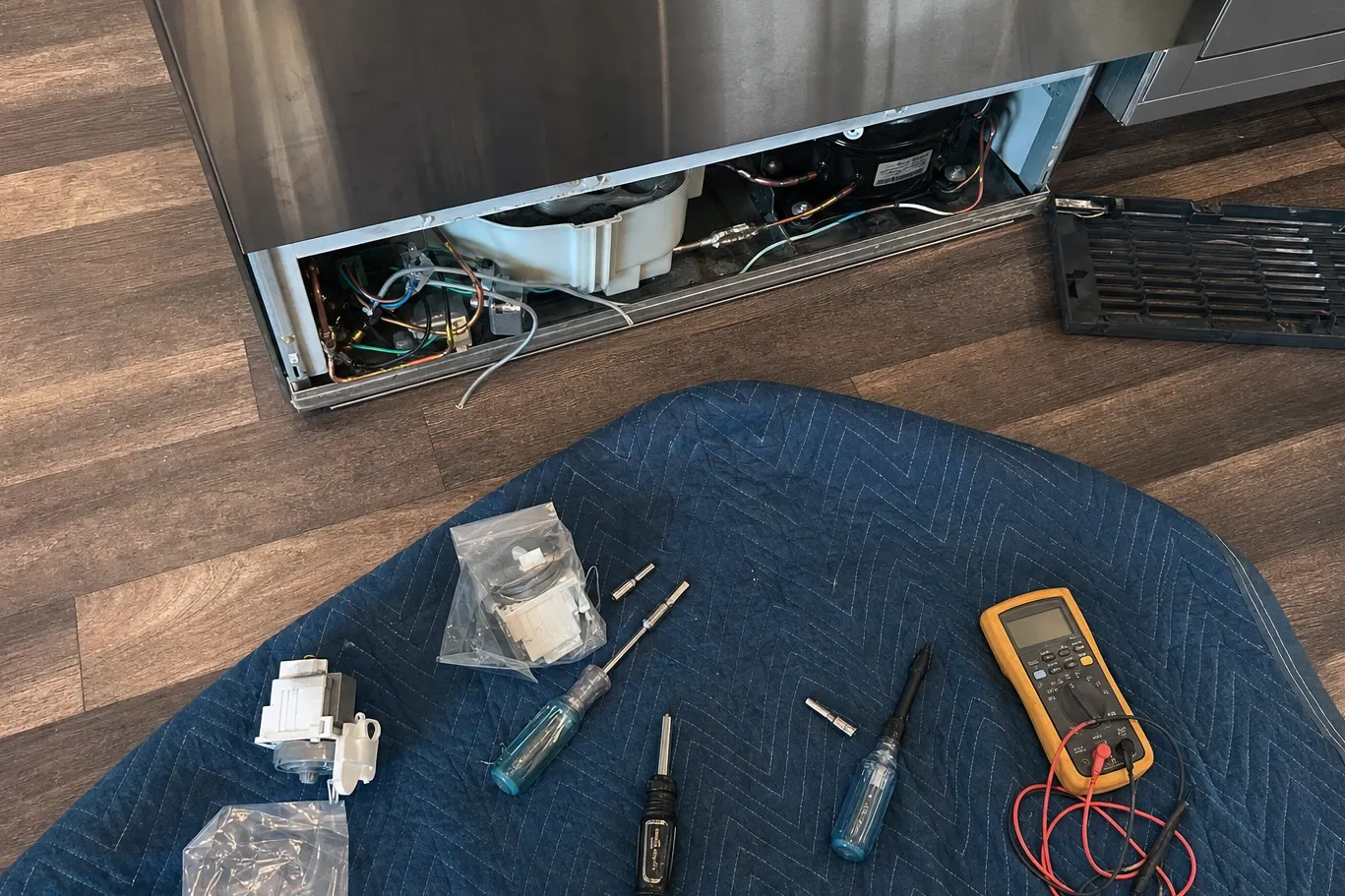
The panel comes off, because none of this can be settled with the panel on. Then, in this order:
- A forced defrost cycle, watched through. Not inferred, not assumed from the frost pattern — entered deliberately and observed. Half the calls end here, because a cycle that never starts and a cycle that starts and does nothing are different faults with different parts behind them.
- Current draw at the defrost heater while that cycle runs. A heater either draws or it does not, and this is a thirty-second measurement.
- Continuity at the terminator, cold and then warm. A terminator that has failed open stops the cycle before it has done anything useful, and it looks from the outside exactly like a dead heater.
- The drain tube, cleared and then proved. Clearing it is easy. Proving it is the part people skip: water goes down it while somebody watches the pan underneath, because a tube that clears and then refreezes at the same point has a different problem again — usually a missing or displaced heat-transfer clip.
- Evaporator fan draw and blade clearance, iced or not. A fan that has been running against ice for a month is often on its way out even after the ice is gone.
- Thermistor readings against a probe on the shelf. If the board is being told the compartment is colder than it is, everything above is downstream of that.
Why this is worth catching early on Chicago’s north side
Two things about the housing stock here make this call more common than it should be. The first is that a great many of these cabinets are twenty years old and still perfectly good, which means the defrost heaters and terminators in them are also twenty years old and are the parts most likely to be at the end of their life. The second is heating season: from October to April these flats run dry, warm air, and every door opening drags a bit more moisture-carrying air into a compartment whose drain is already marginal.
The result is a fault that reads as seasonal but is not. It simply became visible in the winter, and it was already in progress in the autumn.
There is one more reason not to leave it. A blocked drain that keeps refreezing eventually pushes water past the liner and into the insulation, and wet insulation does not dry out. That is the point where an inexpensive drain job turns into an argument about whether the cabinet is worth keeping — and on this stock the answer is almost always yes, right up until it is not.
What to do before you call anyone
Empty the compartment and photograph where the ice is. Take a thermometer reading at the shelf and write down what the display claims at the same moment; the gap between those two numbers is the single most useful thing you can hand a technician. Check whether the drawer below is sitting on ice. Then leave it alone.
What is not worth doing is another manual defrost. It buys a week, it tells you nothing you do not already know, and every cycle of melt-and-refreeze moves a little more water into places it should not be.
Follow-ups
- Can I keep using the compartment while it is doing this?
- Usually yes, as long as the shelf temperature is still at or below 0°F when you check it with a thermometer rather than reading the panel. What you should not do is keep loading it to the back wall — the more the return air path is blocked, the faster the ice rebuilds and the harder the fan works against it.
- Is a hair dryer or a steamer a bad idea?
- A steamer used gently is how the trade clears a plugged drain, but a hair dryer aimed at a liner is how a liner gets deformed, and heat aimed at a foam-backed panel can lift it. If you are melting the ice yourself, switch the unit off and let it stand with the door open on towels. Slower, and nothing gets warped.
- Why does it always come back in the same place?
- Because the water is arriving from the same place. Meltwater that cannot reach the drain refreezes at the lowest point it can get to, which is why the pattern repeats. That repeatability is useful — it tells you the fault is plumbing and airflow rather than something intermittent in the electronics.
- How long should a defrost cycle take?
- Long enough to clear the evaporator completely, then stop. What matters on a service call is not the number of minutes but whether the cycle is being entered at all, whether the heater is drawing current when it does, and whether the terminator is opening at the right point. All three are measurable in one visit.