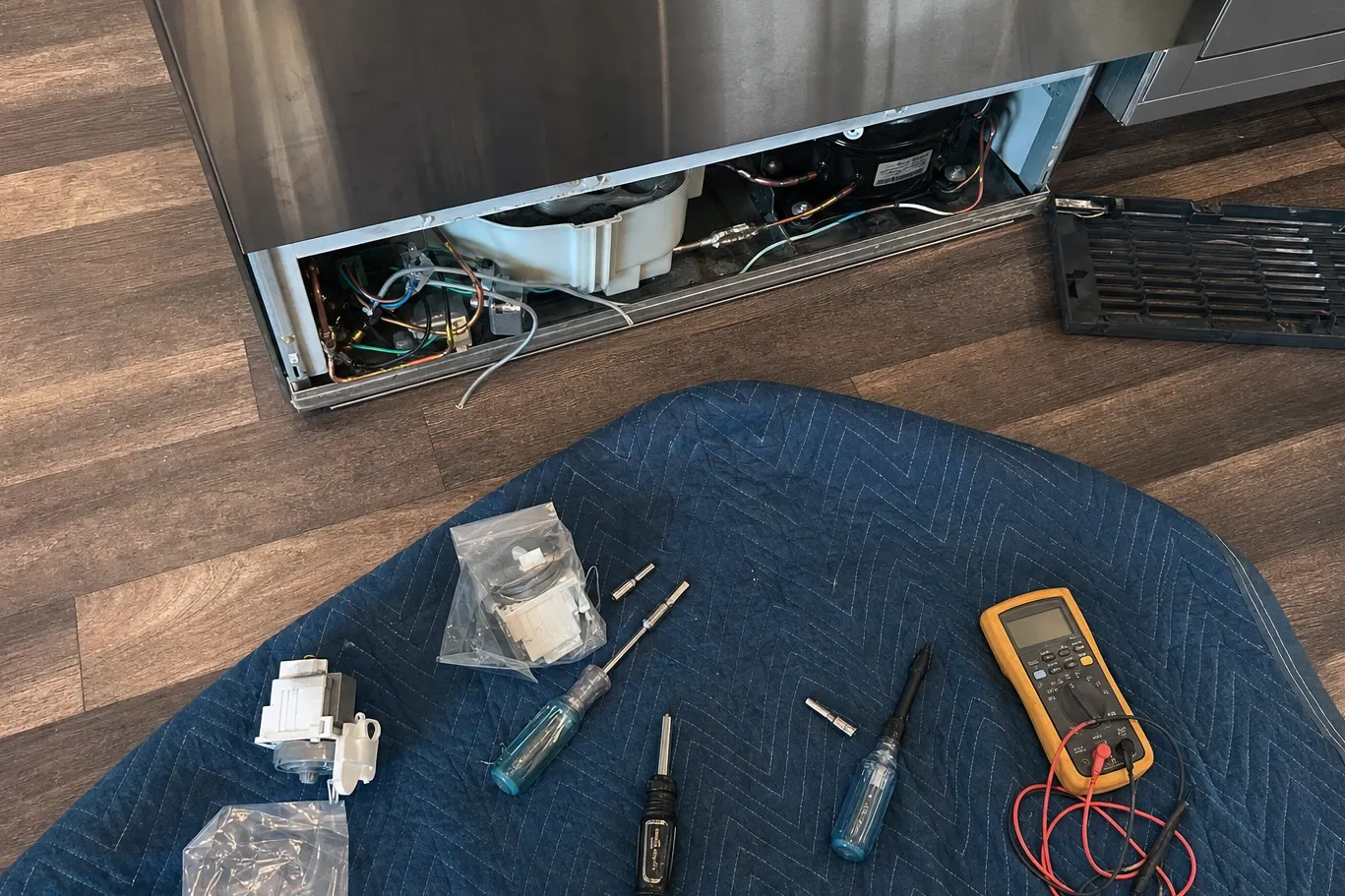
Refrigerator Repair · Lincoln Park
Boxed Into the Joinery: When Clearance Reads Like a Dying Compressor
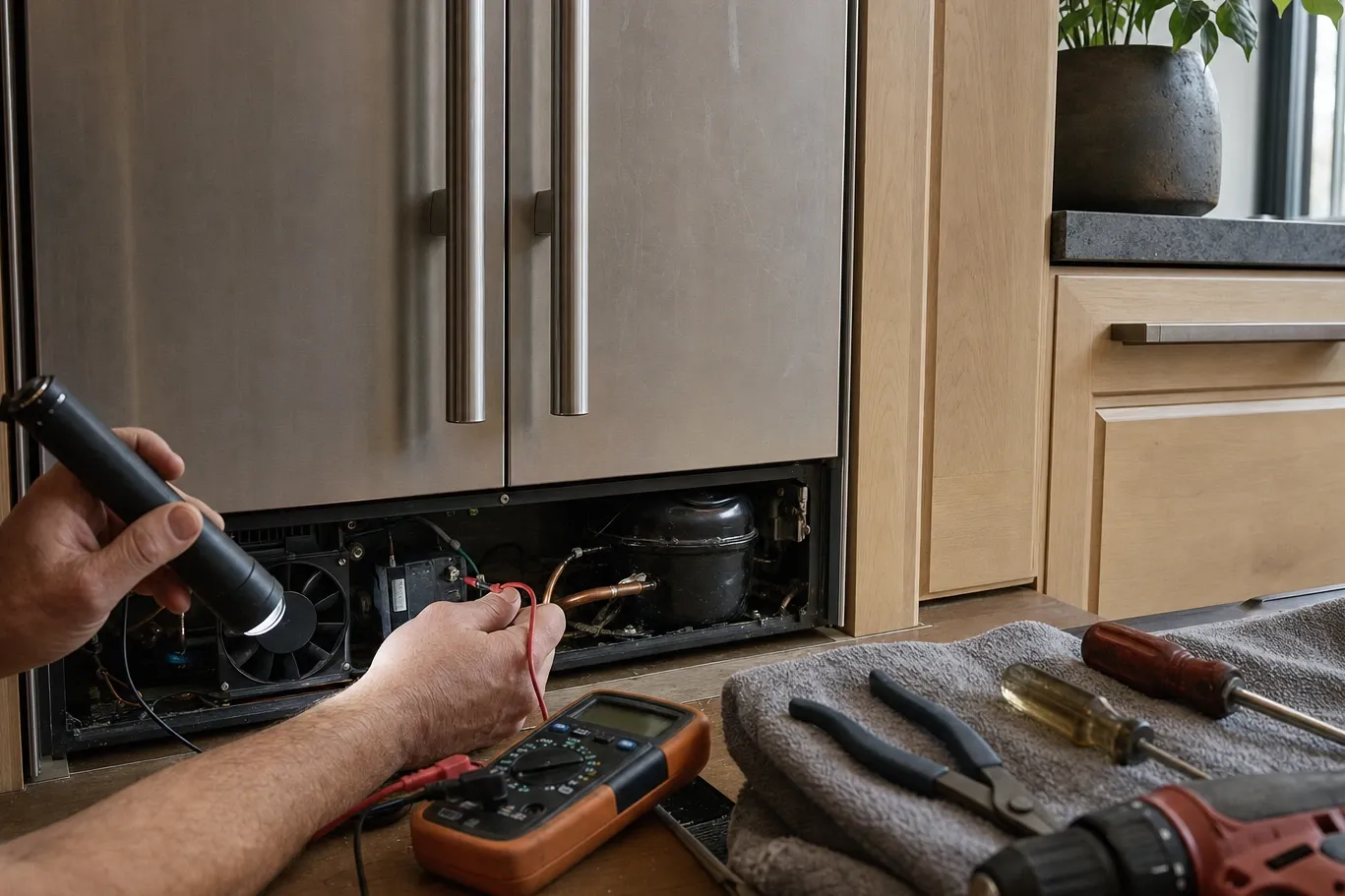
Someone rings and describes a compressor that “never shuts off”. The cabinet is sitting at 44°F instead of 38°F, it has been getting slowly worse for a month, there is no code on the display, and the freezer side is more or less fine. The obvious reading is a sealed system on its way out, and on a twenty-year-old built-in that is an expensive sentence.
In a gut-rehabbed kitchen it is frequently the wrong reading. Cold is not manufactured inside the cabinet; heat is carried out of it and handed to the surrounding room. If the space that heat is being handed to is a sealed cavity of joinery, the machine is doing precisely what it was built to do and losing anyway — and on the gauges that looks a great deal like a machine which is genuinely failing.
What “boxed in” actually means
A built-in rejects its heat through a condenser coil behind the grille at the base. Air is drawn in low, passes across the coil, and is pushed out again. The whole arrangement assumes that the air arriving is roughly room temperature and that the air leaving goes somewhere else.
Three things in a rehab quietly break that assumption:
- Joinery scribed tight to the case. Panel-ready fronts and fillers are fitted to look seamless, and a seamless install is one with no gap for return air.
- A toe-kick that was never cut. The grille is there, and behind it is a solid plinth. Air is drawn in and meets the back of the cabinetry.
- A blocked exit above or behind. A cupboard built over the unit for storage, or a wall furred out for pipework, closes off the path the warm air was meant to leave by.
Any one of them turns the cavity into a loop. The unit exhausts warm air, the same air is drawn back over the coil a few seconds later, and each pass makes it warmer. The compressor keeps running because the cabinet is not reaching setpoint, and the longer it runs the more heat it adds to the space it is trying to reject into.
Why the gauges alone will not settle it
This is the part that costs people money. Restricted airflow across a condenser raises head pressure and raises discharge temperature — and so does a sealed-system fault. Put gauges on a boxed-in cabinet on a warm afternoon and the readings look convincingly like a system in trouble. If the diagnosis stops there, a compressor gets quoted, fitted into exactly the same cavity, worked just as hard, and the fault is back within a season.
So the sequence matters more than the instrument. Clearance and airflow are established first, and only then do the pressures mean anything, because the same number carries two entirely different diagnoses depending on what the air is doing.
The tell that separates them is time and temperature. A heat-rejection problem tracks the kitchen: the cabinet holds overnight, drifts through the afternoon, recovers by morning, and is markedly worse in a warm spell. A sealed-system fault does not care what time it is. Ask when it is worst and you have usually halved the list before anything is opened.
What a proper visit does about it
- Measures the cavity, not only the unit. Return path, exhaust path, and what is actually behind the plinth. Five minutes, and it is the reason the rest of the readings can be trusted.
- Reads the air, in and out. Temperature at the intake and at the exhaust. A small difference means air is moving; a large one means it is not moving enough, and a hot intake means the unit is drinking its own exhaust.
- Checks the coil and the fan before the refrigerant. A coil packed with dust and pet hair, or a fan that has lost speed, produces the same symptom as bad cabinetry and is far cheaper to put right.
- Only then puts gauges on — under load, in the afternoon, when the fault is actually present rather than when it is convenient.
- Says plainly which one it is. If the sealed system is genuinely down, that gets quoted. If the cabinet is being suffocated, the honest answer is joinery work and a coil clean, and that answer is worth more than a compressor.
Living with the answer nobody wants
The awkward outcome is the one where the diagnosis is right and the fix is carpentry. Cutting a return path into a plinth, venting a cupboard above, or opening up a filler is not appliance work, and it is not what anyone wants to hear about a kitchen they have just finished paying for.
It is still cheaper than the alternative by a wide margin, and it is permanent. A cabinet that can breathe stops running continuously, stops drifting in the afternoon, and stops eating condenser fans. The units in these buildings are generally worth that effort — they were built to be serviced and kept, and most of them have plenty left in them.
What is worth avoiding is the middle path: replacing parts, one at a time, into a cavity that will keep killing them. Two fan motors in three years is not bad luck. It is one fault, being paid for repeatedly.
Follow-ups
- How much clearance does a built-in actually need?
- It varies by model family, and the figure that matters is in the installation instructions for your specific unit rather than in a general rule. What is universal is the principle: air has to be able to reach the condenser and then get away from it. A cabinet that draws at the base and exhausts back into its own cavity is recirculating its own hot air, whatever the dimensions say.
- Can I take the toe-kick grille off and leave it off?
- It will help, and it is a reasonable thing to do for a few days while you wait for a visit. It is not a fix — the grille also directs air across the coil, so running without it changes the flow as well as opening it up. Treat it as a diagnostic instead: if the cabinet holds noticeably better with the grille off, you have most of your answer.
- The unit is quieter than it used to be. Is that good?
- Not necessarily. A condenser fan that has slowed down is quieter, and so is one that has stopped. Any change in the noise a cabinet makes is worth mentioning on the phone, in either direction — what matters is what changed rather than whether it got louder.
- If the clearance was wrong from the start, why did it work for years?
- Because it was inside its margin. A cabinet with restricted airflow runs hotter and works harder from the first day, and copes, until something takes the last of that margin away: a coil that has gradually loaded up, a fan that has slowed, a hot week, a kitchen that got warmer after a remodel. Nothing broke on the day it stopped holding.